
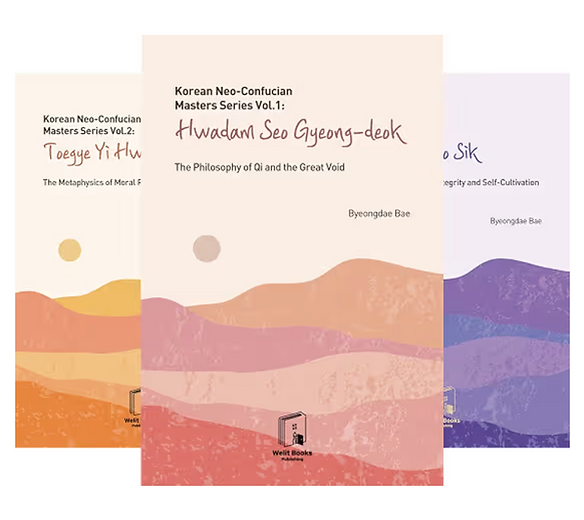
The Korean Neo-Confucian Masters Series, a seven-book series, introduces major Korean Confucian thinkers and highlights the depth, diversity, and originality of Korean Neo-Confucianism within global scholarship. Although Song–Ming Confucianism in China and its Japanese reinterpretations have received extensive academic attention, Korean Confucianism has often remained comparatively peripheral. This series seeks to broaden recognition of Korea’s contribution to East Asian philosophy.
The seven featured scholars are Hwadam Seo Gyeong-deok (1489–1546), Toegye Yi Hwang (1501–1570), Nammyeong Jo Sik (1501–1572), Yulgok Yi I (1536–1584), Uam Song Si-yeol (1607–1689), Nokmun Im Seong-ju (1711–1788), and Nosa Gi Jeong-jin (1798–1879). Together, they represent nearly four centuries of Joseon intellectual history and demonstrate that Korean Neo-Confucianism was not simply a passive inheritance of Chinese thought. Rather, it was a dynamic and evolving tradition shaped by changing political, social, and intellectual circumstances.
Their writings address a broad range of subjects, including metaphysics, moral psychology, education, governance, public responsibility, and cultural identity. Collectively, they reveal how Confucian philosophy functioned not merely as academic inquiry but as a lived tradition grounded in ethical commitment and civic responsibility.
The series has three principal aims: to introduce the richness of Korean Neo-Confucian thought to global readers; to position Korean Confucianism within East Asian and world intellectual history; and to explore its continuing relevance to contemporary questions of ethics, education, governance, and cultural identity.
Ultimately, the series seeks to broaden philosophical discourse by demonstrating Korea’s significant contribution to the shared pursuit of moral understanding and human flourishing.
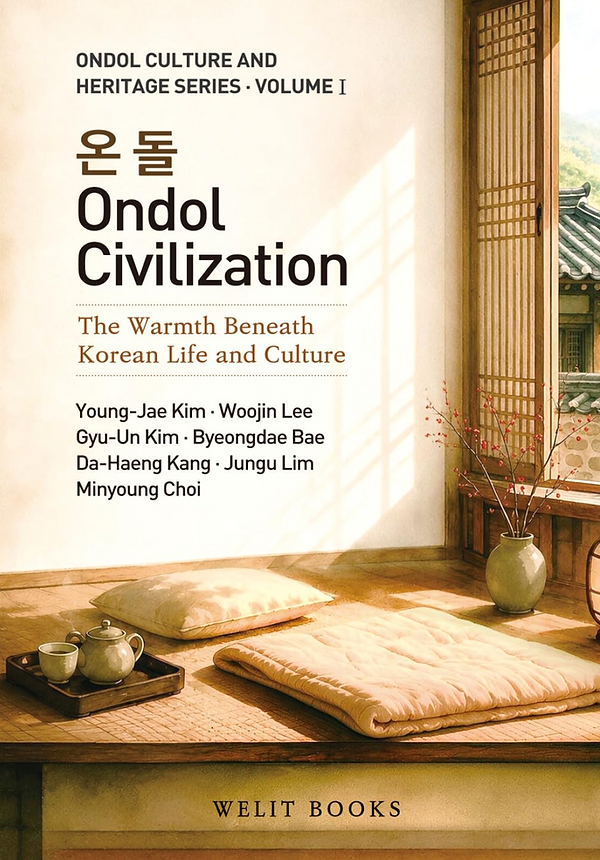
Ondol Civilization explores the deep relationship between Korea’s traditional underfloor heating system, ondol, traditional architecture, and everyday social life. More than a heating technology, ondol became a foundation of Korean domestic culture and shaped how families organized space, seasons, relationships, and daily routines.
The global significance of ondol was highlighted in the 1910s when American architect Frank Lloyd Wright encountered a heated “Korean room” in Tokyo. Impressed by its invisible and evenly distributed warmth, Wright adapted the principle for modern radiant floor heating in Western architecture. In Korea, however, ondol developed beyond its technological function into a distinctive way of living.
Traditional ondol used an outdoor firebox to send heat and smoke through stone flues beneath the floor before releasing them through a chimney. The same fire could cook food while storing heat in the floor for extended periods. This system transformed domestic space. Warm floors allowed people to remove their shoes and use minimal, low furniture, enabling a single room to function as a dining room, study, family space, or bedroom. Seasonal life was also organized around temperature: families enjoyed elevated, ventilated wooden spaces during summer and gathered in warm ondol rooms during winter.
Ondol also shaped social ethics. The warmest area of the floor was commonly offered to elders, guests, postpartum mothers, or the sick. Through such ordinary household practices, principles of respect, hospitality, and Confucian social values were embodied in everyday life.
Modern Korean homes have replaced traditional fireboxes and stone flues with hot-water pipes beneath concrete floors, preserving the comfort of radiant warmth while transforming its technology. As traditional masonry skills, firebox practices, and seasonal customs decline, however, important dimensions of ondol culture risk being lost.
Ultimately, Ondol Civilization argues that safeguarding ondol requires preserving not only physical structures and technologies, but also the memories, values, hospitality, and cultural practices that developed around the warm floor.
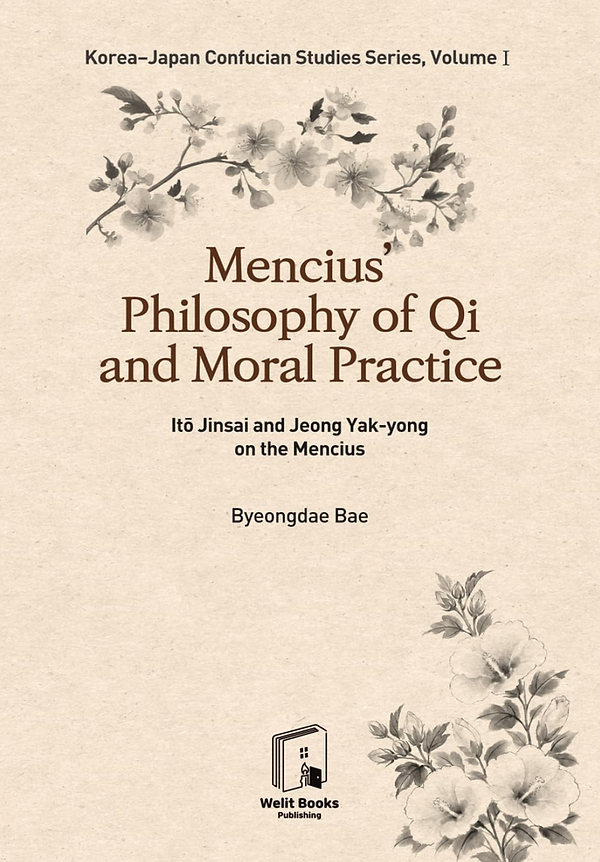
Itō Jinsai (1627–1705) and Jeong Yak-yong (1762–1836) were influential Confucian thinkers of Tokugawa Japan and late Joseon Korea who both engaged deeply with Mencius to reconsider human nature, moral cultivation, and ethical practice. This volume compares their interpretations, focusing particularly on the Mencian theme of “knowing words and nourishing qi” (知言養氣).
The study examines Jinsai’s Ancient Meanings of the Mencius (孟子古義) and Jeong Yak-yong’s Essentials of the Mencius (孟子要義), with particular attention to “flood-like qi” (浩然之氣), intention (志), righteousness (義), the heart-mind (心), and self-cultivation. Jinsai employed his method of recovering the ancient meaning of classical texts, emphasizing linguistic context, moral experience, and the practical force of the Mencius.
Jeong Yak-yong approached the text through philological analysis, evidential comparison, moral discipline, and human responsibility. The book argues that Korean and Japanese Confucianism should not be understood as isolated intellectual traditions. Although Jinsai and Jeong lived in different historical contexts, both worked within a shared Confucian textual world. Their differing interpretations demonstrate how the same classical texts could generate distinctive understandings of qi, righteousness, moral courage, and ethical practice.
The volume also introduces the broader purpose of the Korea–Japan Confucian Studies Series, which seeks to place Korean and Japanese Confucianism within the wider history of East Asian intellectual thought. Korean and Japanese scholars engaged in many of the same classics—including the Analects, Mencius, Zhu Xi’s writings, and works on ritual, self-cultivation, moral philosophy, and practical learning—while developing different philosophical questions and responses. Rather than emphasizing influence or hierarchy, the series examines shared texts, divergent interpretations, and intellectual dialogue, revealing both the connections and distinctive characteristics of Korean and Japanese Confucian traditions.